Handwoven Raffia Storage Baskets
Most storage baskets are pressed into shape in a factory. These are woven by hand, one strand at a time, from raffia palm fibre.
Raffia is stripped from the young leaves of the raffia palm and dried in the sun until it turns from green to a warm sand colour. It comes off the leaf as a flat ribbon — soft enough to bend around a curve, strong enough to hold a tight structural weave. That combination is why raffia baskets keep their shape on a shelf instead of sagging inwards the way softer fibres do.
Each one holds its form when empty, takes weight without splaying, and weighs almost nothing when you lift it down.
Why Raffia Makes a Better Storage Basket
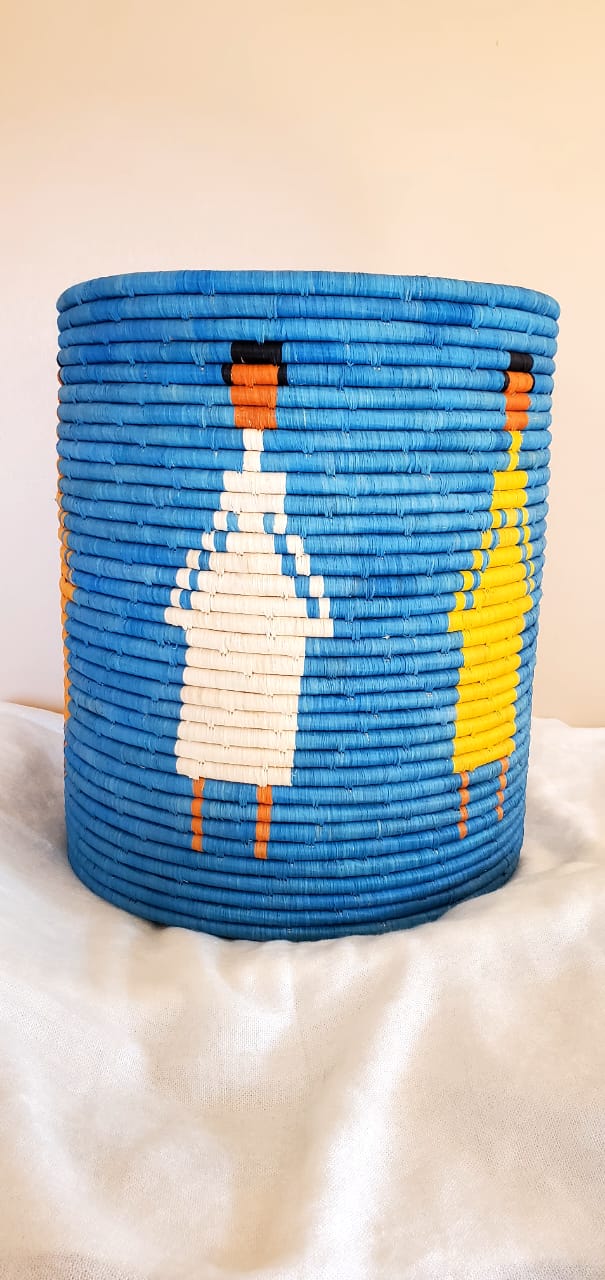
It holds its shape. Raffia fibre is pliable while it’s being woven and firm once it’s dry. A finished basket stands up on its own, so it works on an open shelf where a slumping basket would look untidy.
It’s light. You’ll notice this the first time you lift a full one down from a wardrobe top. The fibre itself weighs very little, so almost all of the weight you’re carrying is what you put inside.
It breathes. The weave is open at fibre level even when it looks solid, so linens, towels and children’s clothes don’t sit in trapped, stale air the way they do in a plastic box.
It takes colour properly. Raffia dyes evenly and deeply, which is why the coloured baskets read as rich rather than surface-tinted.
It’s quiet in a room. Natural fibre has a texture that plastic and painted wire don’t. A raffia basket reads as part of the room rather than as storage you’re trying to hide.
No two are identical. Hand-weaving means slight shifts in tone, tension and pattern from basket to basket. Yours will be close to the photograph, not a duplicate of it.
What Is Raffia, and Where Does It Come From?
Raffia comes from the raffia palm, Raphia farinifera — a tree that grows in humid, marshy ground across tropical Africa and Madagascar.
The fibre is the thin upper skin of the leaf, taken from young leaves before they fully open. Harvesters peel it from both sides of the leaf and split it into narrow ribbons, typically around 12 to 18mm wide and up to a metre long. The strips are laid out to dry in the sun, shrinking slightly and settling from pale green into the warm straw tone you see in the finished baskets.
What makes it genuinely sustainable is that nothing is felled. Only leaves are cut, and the palm carries on growing and producing for years afterwards. In Madagascar, where most of the world’s raffia comes from, harvesting is restricted to a set season each year so the palms have time to regrow before the next cut.
Where These Baskets Work Best
On open shelving. This is what raffia is best at. Because the baskets stand up without support, a row of them turns cluttered shelving into something deliberate.
As toy storage. Light enough for a child to pull out and push back, with no hard corners or sharp plastic edges. The larger sizes swallow a surprising amount.
For blankets and throws. A raffia basket beside a sofa holds folded blankets without crushing them, and the breathability matters more than people expect for anything wool.
In a nursery. Nappies, muslins, folded babygrows. Natural fibre, no plastic smell, quiet to open at night.
In a bathroom or utility room. Rolled towels, cleaning supplies, laundry odds and ends. Keep them out of direct splash range — see the care section below.
In a hallway. Gloves, hats, dog leads, post. The things that otherwise end up on the stairs.
Raffia, Seagrass, Wicker or Plastic — An Honest Comparison
Natural storage baskets aren’t interchangeable, and raffia isn’t the right answer for every job.
Raffia (ours) is palm leaf fibre, handwoven. It’s the lightest of the natural options, holds its shape reliably, breathes well, and dyes richly. Every basket is unique. It shouldn’t be soaked or scrubbed — a dry or barely damp cloth is the whole cleaning method.
Seagrass is the most common natural storage basket in UK shops, usually woven onto a metal frame. It’s sturdy and cheap, and the frame means it holds a very regular shape. It’s also heavier than raffia, the shape is more uniform because it’s built around a former, and it carries a distinct grassy smell when new that some people like and some don’t.
Wicker and rattan are stiffer and more structural, and will outlast most things. They’re also heavier, more prone to snagging on fabric, and the rigid weave can crack rather than flex if knocked hard.
Plastic is cheaper than all of it, wipes clean, and doesn’t care about damp. It also looks like plastic, doesn’t breathe, and won’t last a decade.
So: if it’s going under a sink or somewhere genuinely wet, buy plastic. If you want something structural for firewood, buy wicker. If you want a light, breathable basket that holds its shape on an open shelf and was woven by hand rather than pressed in a factory, this is the one.
Handmade, Fairly Paid, Naturally Sourced
Every basket here is woven by hand by African artisans, paid directly and fairly for their work.
The material side is straightforward in a way most sustainable storage claims aren’t. Raffia is harvested by cutting leaves, not trees. The palms are left standing and keep producing. There’s no plastic core, no metal frame, no synthetic binding and no factory anywhere in the process — and at the end of a long life, a raffia basket breaks down instead of sitting in landfill.
A plastic storage box is cheaper. It does not support a weaver, and it does not biodegrade.
Caring for a Raffia Basket
Dust it with a dry cloth or a soft brush. That handles most of it.
For a mark, use a barely damp cloth and let it dry fully in open air.
Don’t soak it, machine wash it or scrub the weave. Raffia doesn’t tolerate immersion, and scrubbing lifts fibres.
Keep it out of standing water and away from radiators or direct heat.
If it gets damp, air-dry it naturally and reshape it by hand while it dries.
Store it with something soft inside if it’ll be empty for a long stretch, so it keeps its shape.
Natural fibre lightens gently with time and daylight. That’s the material settling, not wearing out.
Frequently Asked Questions
What is a raffia basket made from? Raffia comes from the leaves of the raffia palm, Raphia farinifera. The thin upper skin is stripped from young leaves, split into narrow ribbons and dried in the sun before being woven by hand. Only leaves are cut, so the palm keeps growing.
Is raffia strong enough for storage?
Yes. Raffia is soft enough to weave tightly but firm once dried, so a finished basket holds its shape under weight rather than sagging. It’s a long-established material for baskets, mats and hats for exactly that reason.
Are raffia baskets sustainable?
Raffia is one of the more genuinely sustainable natural fibres. No tree is felled — only leaves are harvested, and the palm regenerates. In Madagascar, the main growing region, harvesting is limited to a set season each year so the palms can recover. The finished basket is fully biodegradable.
How do you clean a raffia basket?
Dust with a dry cloth or soft brush. For marks, use a barely damp cloth and let it air-dry completely. Never soak, machine wash or scrub a raffia basket.
What’s the difference between raffia and seagrass baskets?
Raffia is palm leaf fibre, woven freehand; seagrass baskets are usually woven onto a metal frame. Raffia is lighter and each basket is unique in shape and tone. Seagrass is heavier, more uniform, and has a distinct scent when new.
Can I use a raffia basket in a bathroom?
Yes, for towels and dry storage. Keep it out of direct splash range and away from standing water, since raffia shouldn’t get repeatedly wet.
Do you offer wholesale?
Yes. We supply shops, stalls and interior stylists at wholesale rates with flexible order quantities. Get in touch to discuss numbers.